How to ride a shared taxi that leaves when it's full
A shared taxi leaves when every seat is sold. Where to find one, how long you'll wait, what a seat costs, and what goes wrong, across ten countries.
 By Muhammed AjmalPublished 6 min read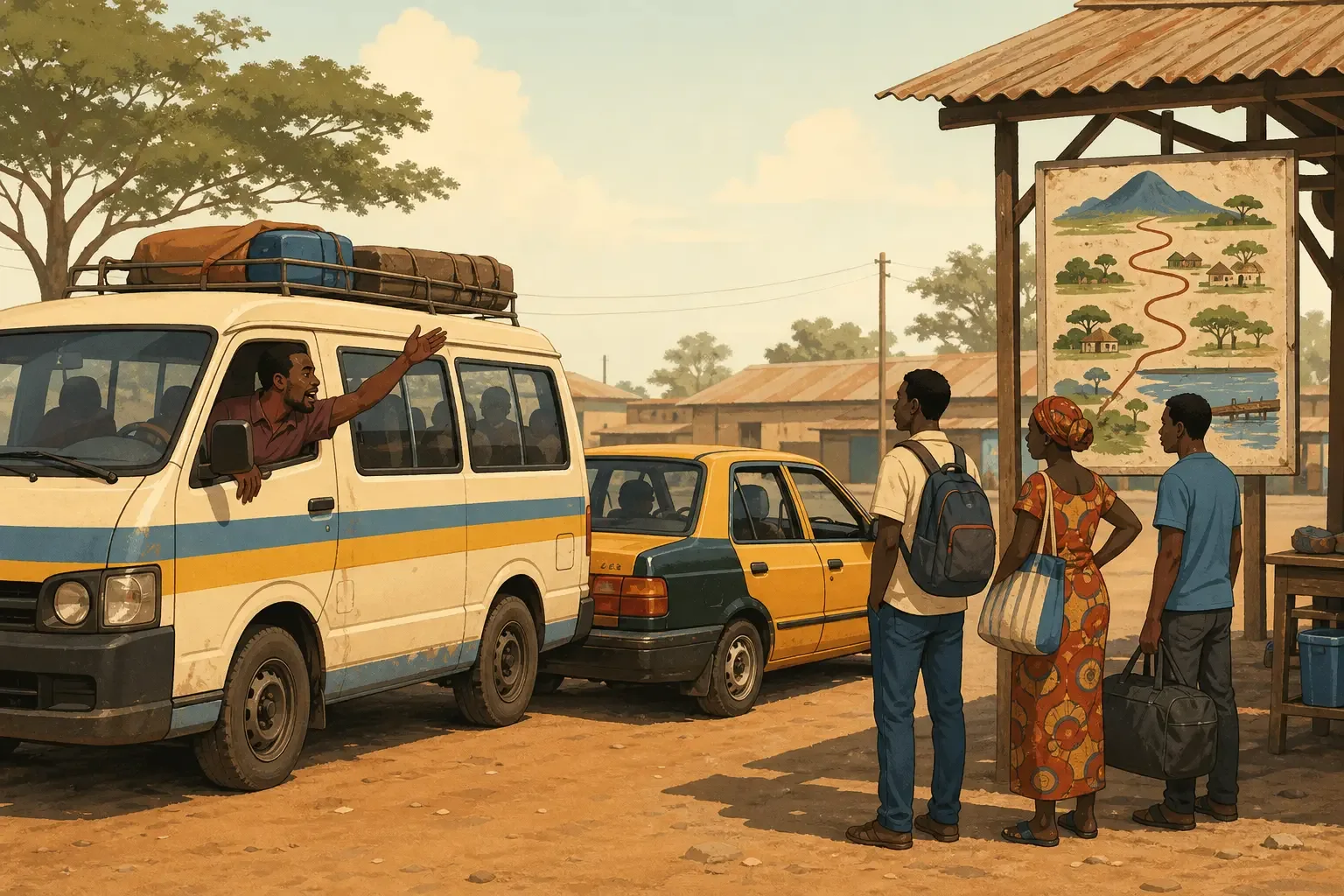
A shared taxi has no timetable. It leaves when every seat is sold.
That one rule moves people on roads in every country below, and it has a different name in each: a Sumo in Meghalaya, a marshrutka in Armenia and Georgia, a matatu in Uganda, a grand taxi in Morocco, a dala-dala in Zanzibar, a V-hire van in the Philippines. Of the 177 places we have researched, dozens have at least one vehicle that waits to fill.
We haven't ridden any of them. What follows comes from guidebooks, operators' pages, local news and travellers' reports that we read in September 2026, and every price carries the year it was reported, because almost none of these systems publishes a tariff. Written on 6 October 2026.
Where you find one
Rarely at the front door of the bus station.
In Entebbe it's the matatu park at Kitooro, behind the 7Seasons Hotel. A matatu you wave down in the town centre is already full and won't stop. In Shillong the shared Sumos for Sohra wait on the upper floor of a multi-storey car park in Bara Bazar, and one traveller calls it a dark parking garage. Look for the board marked Sohra. In Yerevan, the drivers heading for Gyumri call out in a parking lot beside Sasuntsi Davit metro station, next to the main railway station.
In Stone Town the dala-dalas leave from Creek Road at Darajani market, and each one carries a destination board and a route number. 116 goes to Nungwi. 505 goes to the airport. In Georgetown the advice is to ask for the route number, not the place, and to expect touts working the bus parks.
Go to the right patch of ground, say where you're going, and someone will point.
How long you'll wait
It depends on the route and the hour more than the country.
The Entebbe matatu has fourteen seats and usually fills within 15 minutes. Late at night or on a Sunday it can take more than an hour. V-hire vans leaving Dao terminal in Bohol go every 20 to 40 minutes through the middle of the day on the Anda and Ubay roads, with long waits early and late. At Gori, Wikivoyage's advice is to expect a wait for three to five passengers before the van to Tbilisi goes.
On long routes the useful part of the day is shorter than you'd think. Out of Khujand the cars to Dushanbe fill and go all day, but most leave early in the morning, and the last one worth taking is early afternoon if you want to arrive in daylight. The road takes four to five hours. The last van back from Gyumri to Yerevan is reported to leave around 19:00. In Stone Town the dala-dalas thin out well before dark.
You can also pay to leave. In Chefchaouen a grand taxi goes when six passengers are aboard, two sharing the front seat and four across the back. The fare is split equally, so a whole car costs six seats whatever your group size. If you want to leave now, buy the empty ones. Late at night you'll usually have to.
What a seat costs
Almost always per seat, paid to the driver or conductor. We haven't converted currencies, because the rates move faster than these fares do.
| Route | Vehicle | What you pay | Year |
|---|---|---|---|
| Entebbe to Kampala | matatu, 14 seats | UGX 5,000 a person | 2026 |
| Shillong to Sohra | shared Sumo | ₹150 a seat, ₹200 in a smaller car | 2023 |
| Chefchaouen to Tangier | grand taxi, 6 seats | about 70 dirham a seat | 2023 |
| Chefchaouen to Akchour | grand taxi | 30 dirham a person, or 150 for the car | 2023 |
| Khujand to Dushanbe | shared taxi, 4 seats | 120–150 somoni a seat | 2025 |
| Gori to Tbilisi | taxi van | 5 GEL a seat | 2026 |
| Yerevan to Gyumri | marshrutka | 1,500 dram a seat | 2025 |
| Dao to Anda, Bohol | V-hire van, 15 seats | about ₱200 (the bus is ₱160–185) | 2026 |
| Stone Town to Nungwi, Zanzibar | dala-dala 116 | TSh 2,500 | Feb 2024 |
A few things the table hides.
The price depends on who's asking. On the 116 to Nungwi the conductor may push a tourist rate of TSh 5,000 against the normal 2,500. Out of Khujand, haggling of about 20 somoni is normal.
The sums don't always add up. At Akchour the whole car is 150 dirham against 30 a head, which is five seats' worth, even though the car carries six.
And prices move. A seat to Sohra was ₹70 in backpacker reports from 2019 and 2020 and ₹150 in March 2023. No 2026 figure is published, so assume it's higher.
What goes wrong
The way back. Few grand taxis wait at Akchour in the evening, so agree a return time with your driver before they leave you at the trailhead.
The road. The route from Khujand climbs past 3,000 metres, and the section between Ayni and Istaravshan is described as genuinely dangerous in winter and spring; closures can add a day. Around Sohra the monsoon runs from April to October, and a slide can slow or block the road.
The luggage. A dala-dala is hard work with a suitcase and manageable with a backpack. A V-hire van in Bohol puts your knees against the seat in front and your bag on your lap, which is the wrong choice with a big rucksack.
The stand moves. In Georgetown, works outside Stabroek Market from November 2025 pushed the Lodge, Guyhoc and South Ruimveldt buses out of their old parking, so the place you were told about may be a street away.
The fare is a fight. Georgetown minibus fares have been disputed repeatedly between operators and the government, so what's charged and what's approved can be two different numbers.
Three habits that help
Ask another passenger what the fare is before you board. In Chefchaouen, watching what locals hand over is the advice.
Ask whether the price is per seat or for the car. The difference is the whole bill.
In Uganda, tell the conductor "stage" and you can get off anywhere along the road. You pay when you get out.
What we couldn't confirm
None of the fares above come from an official tariff. They're the going rate reported by travellers and guidebooks. Armenian intercity minibuses don't issue tickets, and no operator publishes a price list, so the 1,500 dram is what people say it costs.
The most-used shared ride out of Chefchaouen, to Tetouan, has no confirmed per-seat fare at all. The last shared Sumo back from Sohra to Shillong isn't documented anywhere; the drivers know, and in winter it's safest to assume mid-afternoon. The Zanzibar fares to the airport and to Jambiani are from 2018 and are almost certainly out of date.
If you've ridden one recently and the number is different, tell us through the contact page, and we'll change it and the year.
Frequently asked questions
Is a shared taxi cheaper than a bus?
Sometimes, and not always. In Bohol the V-hire van to Anda costs about ₱200 against ₱160–185 by bus, but it takes about two hours, roughly an hour less. On some routes there is no bus at all: out of Khujand, shared taxis are the only surface way to Dushanbe.
Do I pay before I get in or when I get out?
It varies. In Entebbe you pay the conductor when you get out. In Bohol you tell the dispatcher where you're going and pay before you take a seat. In Gyumri no ticket is issued; you pay the driver.
How many seats does one have?
It depends on the vehicle. The Khujand cars take four. A Chefchaouen grand taxi takes six, with two sharing the front seat. Entebbe matatus have fourteen seats and Bohol V-hire vans fifteen.
Can I book one ahead?
Mostly no. You turn up, take a seat and pay. The exception we found is the jeep from Rurrenabaque to La Paz, where you book a seat at one of the offices on Calle Avaroa the day before; it takes about 12 hours against 14 or more by bus.
What if the car never fills?
Buy the empty seats, as in Chefchaouen, or find another way. If it's late at night or a Sunday, that may be your only option.