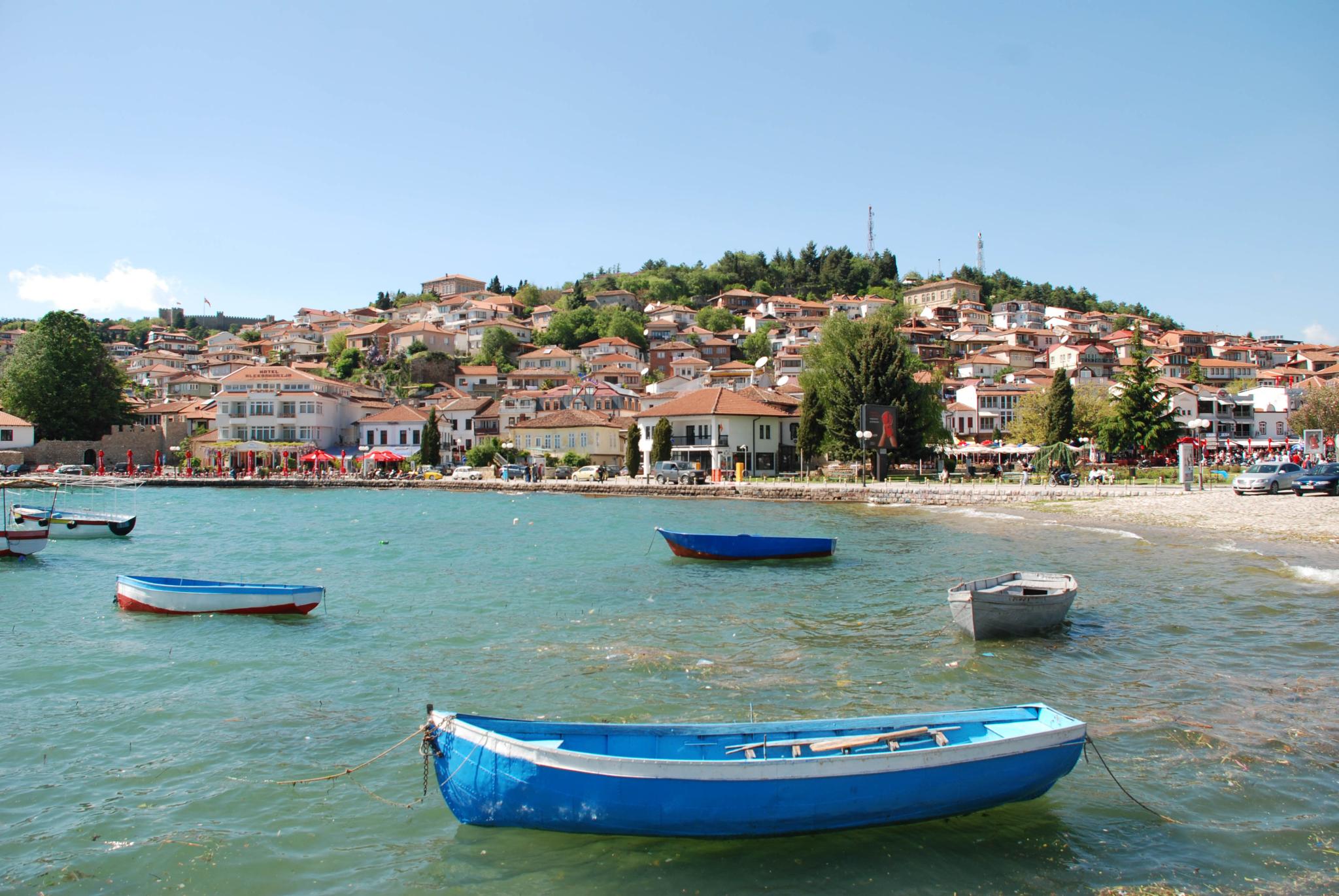
Ohrid
Ohrid is a city in North Macedonia and is the seat of the Ohrid Municipality.
It is the largest city on Lake Ohrid and the eighth-largest city in the country, with it recording a population of over 38,000 inhabitants as of 2021. Ohrid is known for once having 365 churches, one for each day of the year, and has been referred to as the "Jerusalem of the Balkans". The city is rich in picturesque houses and monuments, and tourism is predominant. It is located southwest of Skopje, west of Resen and Bitola. In 1979 and in 1980, respectively, Ohrid and Lake Ohrid were accepted as Cultural and Natural World Heritage Sites by UNESCO. Ohrid is one of only 40 sites that are part of UNESCO's World Heritage that are Cultural as well as Natural sites.
Getting to Ohrid
- 01Bus
- 02Ohrid "St
Paul the Apostle" International Airport (OHD IATA), P.FAH 134 6000, Ohrid 6000 (about 7 km from city centre), +389 46 25 28 30, customer.mk@tav.aero.
Worth seeing
Aside from the lake, Ohrid is most famous for its ancient churches, basilicas, and monasteries where Saints Kliment and Naum with the help of Bulgarian king Boris I (students of Cyril and Methodus) wrote their teachings and formulated the Cyrillic alphabet used in North Macedonia, as well as neighboring countries Bulgaria, Serbia and Montenegro and as far as Russia, and many of the countries of the former Soviet…
- 01Tsar Samuel's Fortress
The fortress sits like a crown above the old town.
- 02Church of Saint Sofia
Dating to the 9th century, Saint Sofia is a cathedral church of the Ohrid Archbishopric.
- 03Church of Saint Mary Perivleptos
- 04Church of Saints Constantine and Elena
Built in 1477, this church sits just southeast of Saint Mary Perivleptos.
- 05Church of Saint Demetrius
Just east of Saint Mary Perivleptos is this 14th century church, dedicated to Saint Demetrius.
- 06Church of Saints Cosmas and Damian
Further southeast of Saints Constantine and Elena, is this small church, also built in the 14th century.
Things to do
Apart from sightseeing, there are a few different natural beaches. Usually, the further from the city centre the more scenic they become, and each offers a unique beach experience. Gradiste beach is known for many young people and music for instance, while others have families or tranquil atmosphere. Beaches are most crowded in July and August, and quiet the rest of the year, which is a whole different experience.
Where to eat
Restaurants and hotels throughout North Macedonia are proudly displaying Ohrid trout (Ohridska pastrmka) on their menus because it is very delicious but it is illegal to catch the fish along the Macedonian shoreline of Lake Ohrid. Please do not support or encourage the consumption of the trout. Ohrid trout, an ancient living fish, is in severe danger. There is also another trout species called Belvica.
- 01Vkusno
Inexpensive and popular, but the waiters are overly busy.
- 02Tomato
- 03Terasa Utarna
Traditional food, Local wine, Terrace, Lake and city view, Open only in summer Dalga (Далга), Kosta Abrash 3,.
Getting around Ohrid the local way
- Get inFrequent local buses (40 denars) and shared taxis (100 denars) to Struga.
- Get inSeasonal charter flights are available by Enter Air to Warsaw–Chopin and LOT Polish Airlines to Katowice.
- Get inAn option is to take the train to Bitola and hitch hiking from there.
From Wikivoyage: Ohrid, CC BY-SA. Not yet checked by us. Last edited 2026-09.
Text adapted from Wikipedia and Wikivoyage, CC BY-SA 4.0. Photograph: Wikimedia Commons (see Commons), Wikimedia Commons.