Ohrid
Ohrid is a city in North Macedonia and is the seat of the Ohrid Municipality.
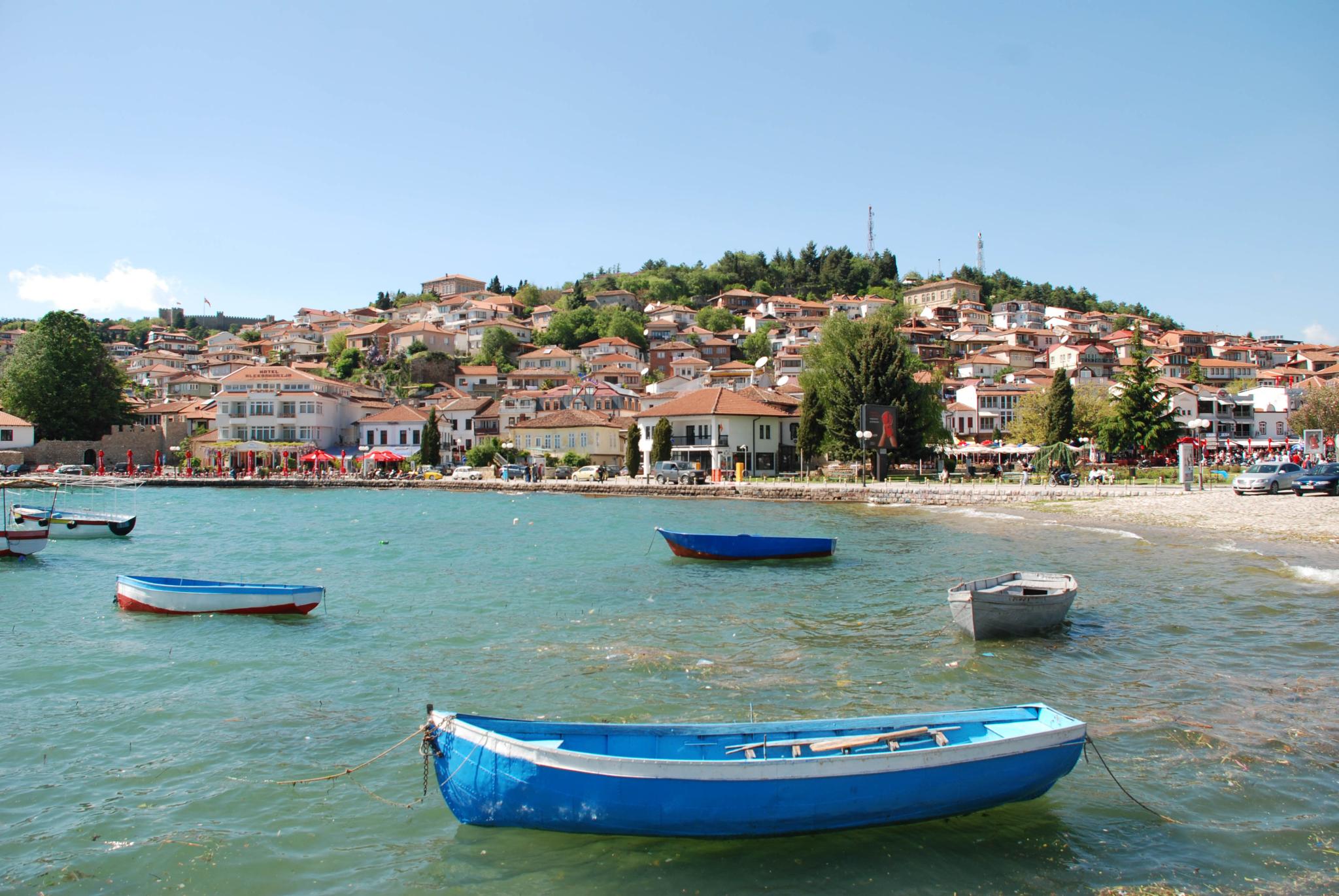
Ohrid is a city in North Macedonia and is the seat of the Ohrid Municipality. It is the largest city on Lake Ohrid and the eighth-largest city in the country, with it recording a population of over 38,000 inhabitants as of 2021. Ohrid is known for once having 365 churches, one for each day of the year, and has been referred to as the "Jerusalem of the Balkans". The city is rich in picturesque houses and monuments, and tourism is predominant. It is located southwest of Skopje, west of Resen and Bitola. In 1979 and in 1980, respectively, Ohrid and Lake Ohrid were accepted as Cultural and Natural World Heritage Sites by UNESCO. Ohrid is one of only 40 sites that are part of UNESCO's World Heritage that are Cultural as well as Natural sites.
Adapted from Wikipedia, CC BY-SA 4.0.
Worth seeing in and around Ohrid
10 places within 25 km that the world writes about, in the order of how widely: the ones a visitor has heard of first, then the ones only a local would name.
- 01Church of St. Sophia
The Church of Saint Sophia is a church in Ohrid, North Macedonia. The church is one of the most important monuments of North Macedonia, housing architecture and art from the Middle Ages.
900 m · church in Ohrid, North Macedonia · Wikipedia - 02Church of St. John at Kaneo
Saint John the Theologian, Kaneo or simply Saint John at Kaneo is a Macedonian Orthodox church situated on the cliff over Kaneo Beach overlooking Lake Ohrid in the city of Ohrid, North Macedonia. The church is dedicated to John of Patmos, the writer of Revelation, who has been by some considered to be the same person as John the Apostle.
1.3 km · Macedonian Orthodox church building in Ohrid, North Macedonia · Wikipedia - 03Samuil's Fortress
Samuel's Fortress is a fortress in the old town of Ohrid, North Macedonia. It was the capital of the First Bulgarian Empire during the rule of Tsar Samuel at the turn of the 11th century.
900 m · archaeological site in Macedonia · Wikipedia - 04Saint Panteleimon
The Church of Saints Clement and Panteleimon is a Byzantine church situated on Plaošnik in Ohrid, North Macedonia. It is attributed to Saint Clement of Ohrid, a disciple of Saint Cyril and Saint Methodius.
1 km · monastery · Wikipedia - 05Ancient Theatre of Ohrid
The Ancient theatre of Ohrid is located in Ohrid, North Macedonia. It was built in 200 BC and is the only Hellenistic-type theatre in the country as the other three in Scupi, Stobi and Heraklea Lynkestis are from Roman times.
700 m · ancient Greek theatre in Ohrid, North Macedonia · Wikipedia - 06University for Information Science and Technology "St. Paul The Apostle"
The University of Information Science and Technology "St. Paul The Apostle" (Macedonian: Универзитет за информатички науки и технологии "Св.
400 m · state university, located in Ohrid, North Macedonia · Wikipedia - 07Plaošnik
Plaošnik or simply Plaoš is an archaeological site and holy place in Ohrid, North Macedonia, located 250 meters south of Samuil's Fortress. The site is in the process of being restored to its original condition.
1 km · archaeological site in Macedonia · Wikipedia - 08Robevi family house
The Robevi House is a famous and historic building in Ohrid, North Macedonia. It was built in its current state in 1863–1864 by Todor Petkov from a village Gari near Debar.
700 m · historic building in Ohrid, Macedonia · Wikipedia - 09Natural and Cultural Heritage of the Ohrid region
Lake Ohrid is a lake which straddles the mountainous border between the southwestern part of North Macedonia and eastern Albania. It is one of Europe's deepest and oldest lakes, with a unique aquatic ecosystem of worldwide importance, with more than 200 endemic species.
1 km · World Heritage Site in North Macedonia · Wikipedia - 10Ali Pasha Mosque
The Ali Pasha Mosque is the main mosque in the city of Ohrid, North Macedonia. It is the seat of a muftiate.
200 m · mosque in Ohrid, North Macedonia · Wikipedia
Ranked by the number of language editions of Wikipedia with an article on each, from Wikidata; the sentences are the openings of those articles, CC BY-SA 4.0.
What Wikivoyage says to see
Aside from the lake, Ohrid is most famous for its ancient churches, basilicas, and monasteries where Saints Kliment and Naum with the help of Bulgarian king Boris I (students of Cyril and Methodus) wrote their teachings and formulated the Cyrillic alphabet used in North Macedonia, as well as neighboring countries Bulgaria, Serbia and Montenegro and as far as Russia, and many of the countries of the former Soviet…
- 01Tsar Samuel's Fortress
The fortress sits like a crown above the old town.
- 02Church of Saint Sofia
Dating to the 9th century, Saint Sofia is a cathedral church of the Ohrid Archbishopric.
- 03Church of Saint Mary Perivleptos
- 04Church of Saints Constantine and Elena
Built in 1477, this church sits just southeast of Saint Mary Perivleptos.
- 05Church of Saint Demetrius
Just east of Saint Mary Perivleptos is this 14th century church, dedicated to Saint Demetrius.
- 06Church of Saints Cosmas and Damian
Further southeast of Saints Constantine and Elena, is this small church, also built in the 14th century.
From Wikivoyage: Ohrid, CC BY-SA 4.0. Not yet checked by us.
Things to do
Apart from sightseeing, there are a few different natural beaches. Usually, the further from the city centre the more scenic they become, and each offers a unique beach experience. Gradiste beach is known for many young people and music for instance, while others have families or tranquil atmosphere. Beaches are most crowded in July and August, and quiet the rest of the year, which is a whole different experience.
From Wikivoyage: Ohrid, CC BY-SA 4.0. Not yet checked by us.
Where to eat
Restaurants and hotels throughout North Macedonia are proudly displaying Ohrid trout (Ohridska pastrmka) on their menus because it is very delicious but it is illegal to catch the fish along the Macedonian shoreline of Lake Ohrid. Please do not support or encourage the consumption of the trout. Ohrid trout, an ancient living fish, is in severe danger. There is also another trout species called Belvica.
- 01Vkusno
Inexpensive and popular, but the waiters are overly busy.
- 02Tomato
- 03Terasa Utarna
Traditional food, Local wine, Terrace, Lake and city view, Open only in summer Dalga (Далга), Kosta Abrash 3,.
From Wikivoyage: Ohrid, CC BY-SA 4.0. Not yet checked by us.
Getting to Ohrid
- Airports
- Ohrid St. Paul the Apostle (OHD), 9 km · Tirana Mother Teresa (TIA), 96 km · Skopje (SKP), 116 km
- Stations
- Ohrid "St. Paul the Apostle" Airport, 8.6 km
- Ilinden → Ohrid117 km · quickest by road, 3h 19m · $15–21
- Rinas → Ohrid98 km · quickest by road, 2h 39m · $12–17
- Prishtina → Ohrid176 km · quickest by road, 4h 13m · $19–26
- Plan a tripFrom anywhereThe planner compares every way there from wherever you are.
Road and air are today’s quick answer; timetabled trains, buses and ferries load on the results page from the operators’ feeds.
No local-transport research exists yet for Ohrid
Our researched notes are written from a sourced entry: every shared taxi, boat and village bus with its operator, its rule, its fare and the year we saw it, and what could not be confirmed. Nobody has done that work for Ohrid. What is above is what we hold from open sources; nothing here pretends to be more.
- Get inFrequent local buses (40 denars) and shared taxis (100 denars) to Struga.
- Get inSeasonal charter flights are available by Enter Air to Warsaw–Chopin and LOT Polish Airlines to Katowice.
- Get inAn option is to take the train to Bitola and hitch hiking from there.
From Wikivoyage: Ohrid, CC BY-SA. Not yet checked by us; that article was last edited 2026-09.
- 01316 km
- 02326 km
- 03330 km
- 04366 km
- 05421 km
If you know how people move in Ohrid – the stand, the rule, the fare – tell us, and the note gets an entry.