Bukhara
Bukhara is the seventh-largest city in Uzbekistan by population, with 305,500 residents as of 2026.
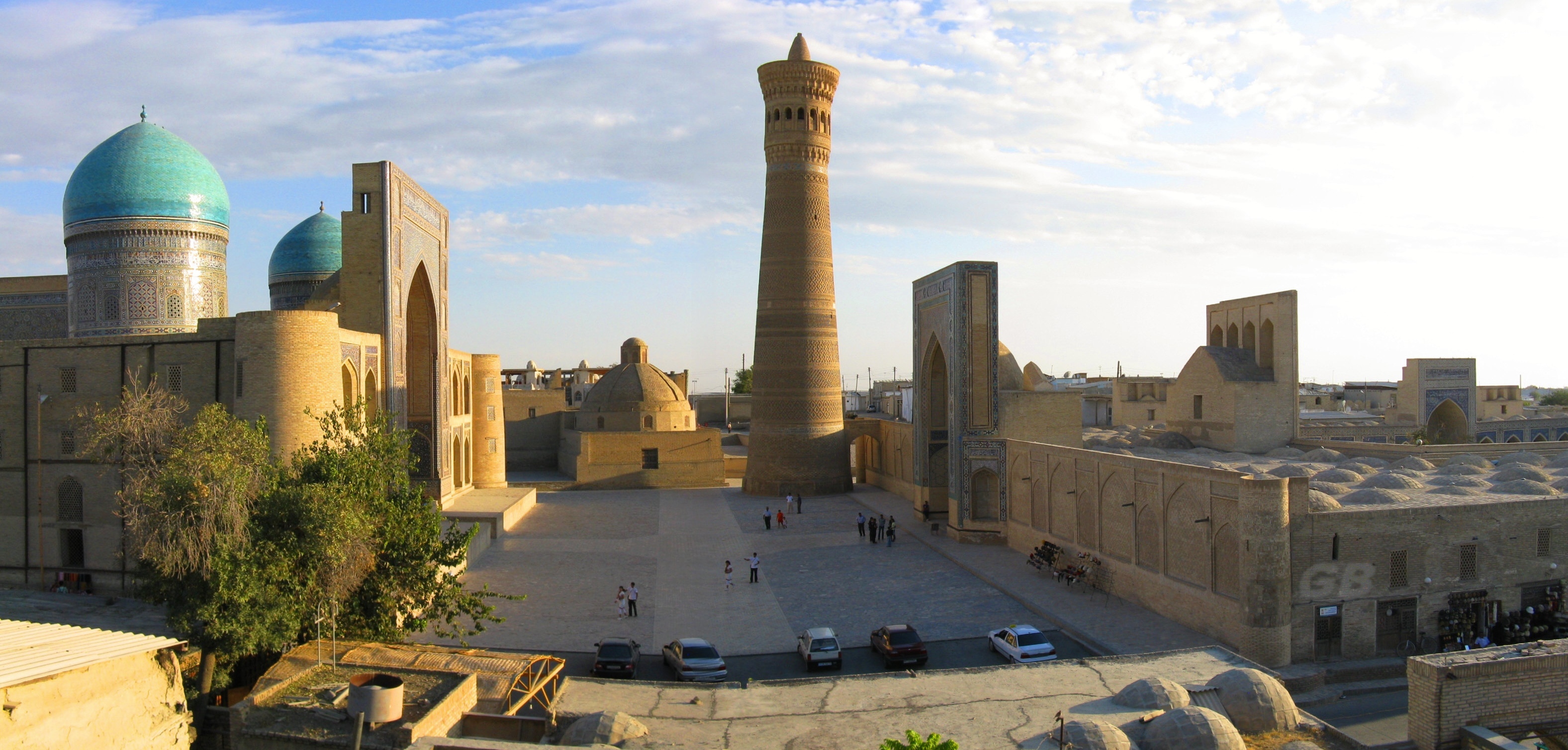
Bukhara is the seventh-largest city in Uzbekistan by population, with 305,500 residents as of 2026. It is the capital of Bukhara Region. Since ancient times, Bukhara was one of the most prosperous cities in Transoxiana alongside neighbouring Samarkand owing to its location on Silk Road. Today its historic core is a UNESCO World Heritage Site.
Adapted from Wikipedia, CC BY-SA 4.0.
Worth seeing in and around Bukhara
10 places within 25 km that the world writes about, in the order of how widely: the ones a visitor has heard of first, then the ones only a local would name.
- 01Kalyan Minaret
The Kalyan Minaret is a minaret of the Po-i-Kalyan mosque complex in Bukhara, Uzbekistan and one of the most prominent landmarks in the city. The minaret, designed by Bako, was built on an earlier existing structure called Kalyan by the Qarakhanid ruler Mohammad Arslan Khan in 1127 to summon Muslims to prayer five times a day.
1.2 km · minaret in Bukhara, Uzbekistan; the last surviving fragment of the Kara-khanid era mosque built by Mohammad Arslan Khan in 1127 · Wikipedia - 02Ark of Bukhara
The Ark of Bukhara is a massive fortress located in the city of Bukhara, Uzbekistan, that was initially built and occupied around the 5th century AD. The Ark's current structure began to develop during the 16th century under the Shaybanid Uzbek dynasty, while all of its existing buildings were constructed in the last three centuries. In addition to being a military structure, the Ark encompassed what was essentially a town that, during much of the fortress's history, was inhabited by the various royal courts that held sway over the region surrounding Bukhara.
1.6 km · fortress located in the city of Bukhara, Uzbekistan · Wikipedia - 03Chor-Bakr
Chor-Bakr is a memorial complex in the village of Sumitan at 5 km of Bukhara in Uzbekistan, built over the burial place of Abu-Bakr-Said, who died in the year 360 of the Muslim Calendar, and who was one of the four of Abu-Bakrs – descendants of Muhammad. The complex includes the necropolis of family tombs, and courtyards enclosed with walls.
7.6 km · memorial complex in Sumitan, Uzbekistan · Wikipedia - 04Chashma-Ayub Mausoleum
Chashma-Ayub Mausoleum is located near the Samani Mausoleum, in Bukhara, Uzbekistan. Its name means Job's well, due to the legend in which Job visited this place and made a well by striking the ground with his staff.
2.2 km · Historic site in Uzbekistan · Wikipedia - 05Chor Minor
Chor Minor, alternatively known as the Madrasah of Khalif Niyaz-kul, is a historic gatehouse for a now-destroyed madrasa in the historic city of Bukhara, Uzbekistan. It is located in a lane northeast of the Lyab-i Hauz complex.
1 km · mosque in Bukhara, Uzbekistan · Wikipedia - 06Magok-i-Attari Mosque
Maghoki Attori Mosque is a historical mosque in Bukhara, Uzbekistan. It forms a part of the historical religious complex of Lyab-i Hauz.
800 m · mosque in Bukhara, Uzbekistan · Wikipedia - 07Bolo Haouz Mosque
Bolo Haouz Mosque is a historical mosque in Bukhara, Uzbekistan. Built in 1712, on the opposite side of the citadel of Ark in Registan district, it is inscribed in the UNESCO World Heritage Site list along with other parts of the historic city.
1.8 km · mosque in Bukhara, Uzbekistan · Wikipedia - 08Kalan Mosque
Kalan Mosque is an architectural monument located in Bukhara, Uzbekistan. It was considered one of the largest mosques built on the place of Jame' Mosque.
1.3 km · Mosque in Bukhara, Uzbekistan · Wikipedia - 09Namazgoh Mosque
The Bukhara Mosque is a historical monument in Bukhara. It is one of the mosques built for praying during Eid festivals.
1.1 km · mosque in Bukhara, Uzbekistan · Wikipedia - 10Baland Mosque
Baland Mosque, which means the "upper mosque", is a historical mosque in the ancient city of Bukhara, Uzbekistan. Registered as a World Heritage Site by UNESCO along with the whole of the historic old town, this small mosque was built at the beginning of the 16th century in the southern part of the city.
1.6 km · mosque in Bukhara, Uzbekistan · Wikipedia
Ranked by the number of language editions of Wikipedia with an article on each, from Wikidata; the sentences are the openings of those articles, CC BY-SA 4.0.
What Wikivoyage says to see
- 01Synagogue
There's been a substantial Jewish community in Bukhara since the 8th century.
- 02Magok-i-Attari Mosque
The oldest surviving mosque building in Central Asia, dating back to the 800s, reconstructed in the 1500s and now a carpet museum.
- 03Khoja Gaukushan
A complex similar to Lyab-i Hauz built in 1570, with a mosque, medressah and hauz.
- 04Toqi Telpak Furushon
This one was the bazaar of the cap-makers.
From Wikivoyage: Bukhara, CC BY-SA 4.0. Not yet checked by us.
Things to do
Hammam Borzi Kord, Mehtar Ambar 55 (within Toqi Telpak Furushon),. Daily 06:00-23:00. Traditional bath house, mornings only for local men then after 14:00 for tourists of mixed gender. Hammom Kunjak, Nurobobod (100 m west of Kalan Mosque),. Daily 09:00-21:00. The women's bathhouse. Most reckon it's an overpriced tourist trap.
From Wikivoyage: Bukhara, CC BY-SA 4.0. Not yet checked by us.
Where to eat
Sometimes local people invite for dinner to their home (i.e. near Kalyan mosque). Consider this authentic experience and leave locals some money after. Bolo Khauz Teahouse, Afrosiab St (next to Bolo Khauz Mosque). Atmospheric restaurant but touristy prices. Doston House, Kokill Kalon 5 (100 m east of Lyab-i Hauz bus stop),. Daily 12:00-15:00, 18:00-21:00.
From Wikivoyage: Bukhara, CC BY-SA 4.0. Not yet checked by us.
Getting to Bukhara
- Airports
- Bukhara (BHK), 5 km · Türkmenabat (CRZ), 119 km · Samarkand (SKD), 219 km
- Stations
- Bukhara International Airport, 5.2 km
- Samarkand → Bukhara217 km · quickest by road, 4h 17m · $24–33
- Urgench → Bukhara377 km · quickest by air, 3h 17m · $130–190
- Tashkent → Bukhara437 km · quickest by air, 3h 26m · $140–210
- Plan a tripFrom anywhereThe planner compares every way there from wherever you are.
Road and air are today’s quick answer; timetabled trains, buses and ferries load on the results page from the operators’ feeds.
No local-transport research exists yet for Bukhara
Our researched notes are written from a sourced entry: every shared taxi, boat and village bus with its operator, its rule, its fare and the year we saw it, and what could not be confirmed. Nobody has done that work for Bukhara. What is above is what we hold from open sources; nothing here pretends to be more.
- Get inShared taxis also arrive here, covering the route in half the time for twice the fare.
- Get inShared taxis run from Qarshi (90 min), Shakhrisabz (4 hours), Termiz on the Afghan border (6 hours) and Denau (6 hours).
- Get aroundThey're sometimes described as marshrutkas or dolmuşes but they have fixed stops and run to a fixed timetable, though its details are known only unto Allah.
From Wikivoyage: Bukhara, CC BY-SA. Not yet checked by us; that article was last edited 2026-09.
- 01274 km
- 02446 km
- 03974 km
- 041,207 km
- 051,323 km
If you know how people move in Bukhara – the stand, the rule, the fare – tell us, and the note gets an entry.
Next door to Bukhara
- Galaasiyahuman settlement9.5 km
- Bukhara Districtdistrict in Uzbekistan9.3 km