Isfahan
Isfahan is a city in the Central District of Isfahan County, Isfahan Province, Iran.
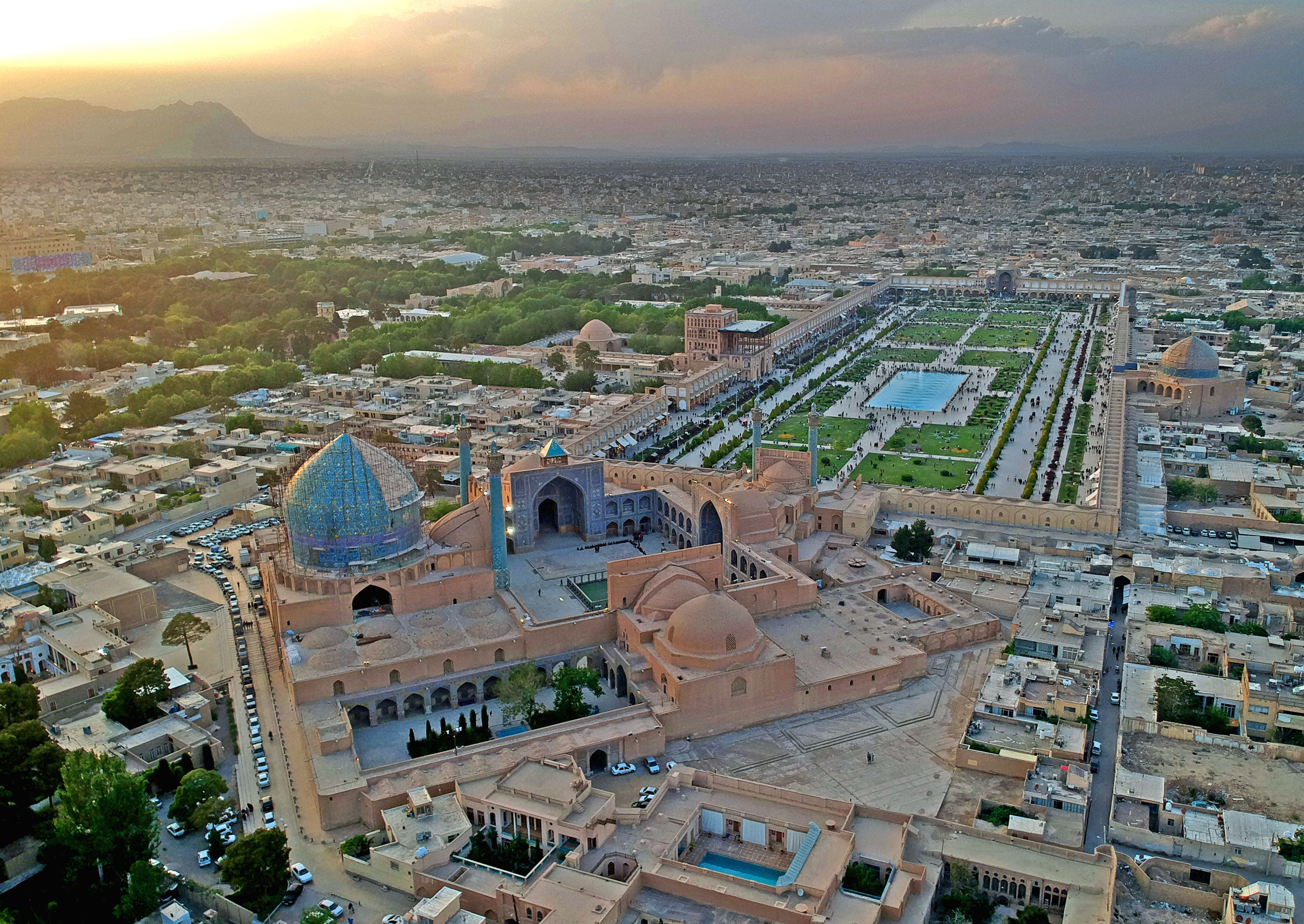
Isfahan is a city in the Central District of Isfahan County, Isfahan Province, Iran. It is the capital of the province, the county, and the district. It is located 440 kilometres south of Tehran. The city has a population of approximately 2,238,000, making it the third-most populous city in Iran, after Tehran and Mashhad, and the second-largest metropolitan area.
Adapted from Wikipedia, CC BY-SA 4.0.
Worth seeing in and around Isfahan
10 places within 25 km that the world writes about, in the order of how widely: the ones a visitor has heard of first, then the ones only a local would name.
- 01Naqsh-e Jahan Square
The Naqsh-e Jahan Square, also known as the Shah Square prior to 1979, and sometimes known as the Imam Square, is a square situated at the center of Isfahan, Iran. Constructed between 1598 and 1629, it is now an important historical site, and one of UNESCO's World Heritage Sites.
1 km · square in Isfahan, Iranian national heritage site · Wikipedia - 02Jameh Mosque of Isfahan
The Jāmeh Mosque of Isfahān or Jāme' Mosque of Isfahān, also known as the Atiq Mosque and the Friday Mosque of Isfahān, is a historic congregational mosque, located in Isfahan, Iran. The mosque is the result of continual construction, reconstruction, additions and renovations on the site from c. 771 CE to the end of the 20th century.
1.5 km · mosque in Isfahan, Iranian national heritage site and World heritage site · Wikipedia - 03Shah Mosque
The Shah Mosque, also officially known as the Imam Mosque or Imam Khomeini Mosque, is a mosque located on the south side of Naqsh-e Jahan Square in Isfahan, in the province of Isfahan, Iran. Its construction began in 1611, during the Safavid Empire under the order of Abbas the Great, and was completed c. 1630.
1.4 km · mosque in Isfahan, Iranian national heritage site · Wikipedia - 04Sheikh Lotfollah Mosque
The Sheikh Lotfollah Mosque is a Shi'ite mosque, located on the eastern side of Naqsh-e Jahan Square, Isfahan, Iran. Construction of the mosque started in 1011 AH and was finished in 1028 AH.
1.2 km · mosque in Isfahan, Iranian national heritage site · Wikipedia - 05Si-o-se Pol
}} The Allahverdi Khan Bridge, popularly known as Si-o-se-pol, is the largest of the eleven historical bridges on the Zayanderud, the largest river of the Iranian Plateau, in Isfahan, Iran. The bridge was built in the early 17th century to serve as both a bridge and a dam.
2.3 km · bridge in Isfahan, Iranian national heritage site · Wikipedia - 06Chehel Sotun
Chehel Sotoun is a 17th century pavilion and garden, in Isfahan, Iran. It was commissioned by Abbas the Great and completed by Shah Abbas II, both Safavid Shahs, mostly for royal entertainment and receptions.
900 m · palace in Isfahan, Iranian national heritage site · Wikipedia - 07Vank Cathedral
The Holy Savior Cathedral, also known the Church of the Saintly Sisters, is an Armenian Apostolic cathedral located in the New Julfa district of Isfahan, Iran. It is commonly referred to as the Vank, which means "monastery" or "convent" in the Armenian language.
3.6 km · cathedral in Isfahan, Iranian national heritage site · Wikipedia - 08Ali Qapu
Ali Qapu is an imperial palace in Isfahan, Iran. It is located on the western side of Naqsh-e Jahan Square, opposite to Sheikh Lotfollah Mosque, and had originally been designed as a vast portal entrance to the grand palace which stretched from the square to Chaharbagh Boulevard.
1.1 km · palace in Isfahan, Iranian national heritage site · Wikipedia - 09Hasht Behesht Palace
Hasht Behesht or Hasht-Behesht is a 17th-century pavilion in Isfahan, Iran. It was built by the order of Suleiman I, the eighth shah of Safavid Iran, and functioned mainly as a private pavilion.
1.3 km · palace in Isfahan, Iranian national heritage site · Wikipedia - 10Khaju Bridge
}} The Khaju Bridge is a historic bridge on the Zayanderud, the largest river of the Iranian plateau, in Isfahan, Iran. Serving as both a bridge and a weir, it links the Khaju quarter on the north bank with the Zoroastrian quarter across the Zayanderud.
3.4 km · bridge in Isfahan, Iranian national heritage site · Wikipedia
Ranked by the number of language editions of Wikipedia with an article on each, from Wikidata; the sentences are the openings of those articles, CC BY-SA 4.0.
What Wikivoyage says to see
- 01Naqsh-e Jahan Square
Also known as shah square or imam square-1602 (Meidan Emam).
- 02Chaharbagh Boulevard
1596, dating from the Saffavid era, the avenue is the most historically famous in all of Persia.
- 03Meydan Kohne
The stunning mosques of Isfahan are among the most beautiful and interesting in the world.
- 04Imam Mosque
- 05Sheikh Lotf Allah Mosque
One of the architectural masterpieces of Safavid Iranian architecture, this mosque is considered to be the most beautiful in Iran.
- 06Masjed-e Jāmé of Isfahan
From Wikivoyage: Isfahan, CC BY-SA 4.0. Not yet checked by us.
Where to eat
In some parks, you can simply obtain a carpet and tea from the park warden, and have a picnic on the grass! You will find families gather in these parks, and bring barbecues and cook freshly made kebabs, which smell (and taste) delicious. Na'an is Persian for bread and the word is used in various Indian languages for their version of Persian-style bread. That can be excellent, but some prefer the Persian original.
- 01Shahrzad
Abbas Abad St (nearing The Bridge of 33 Arches),.
From Wikivoyage: Isfahan, CC BY-SA 4.0. Not yet checked by us.
Getting to Isfahan
- Airports
- Isfahan Shahid Beheshti (IFN), 22 km
- Tehran → Isfahan339 km · quickest by air, 4h 44m · $180–260
- Ahvaz → Isfahan319 km · quickest by air, 4h 44m · $180–260
- Karaj → Isfahan359 km · quickest by air, 5h · $200–290
- Plan a tripFrom anywhereThe planner compares every way there from wherever you are.
Road and air are today’s quick answer; timetabled trains, buses and ferries load on the results page from the operators’ feeds.
No local-transport research exists yet for Isfahan
Our researched notes are written from a sourced entry: every shared taxi, boat and village bus with its operator, its rule, its fare and the year we saw it, and what could not be confirmed. Nobody has done that work for Isfahan. What is above is what we hold from open sources; nothing here pretends to be more.
- Go nextIt is a quaint traditional desert village and it is easy to get to from the Jey Minibus terminal.
From Wikivoyage: Isfahan, CC BY-SA. Not yet checked by us; that article was last edited 2026-09.
- 01972 km
- 021,029 km
- 031,140 km
- 041,221 km
- 051,232 km
If you know how people move in Isfahan – the stand, the rule, the fare – tell us, and the note gets an entry.